
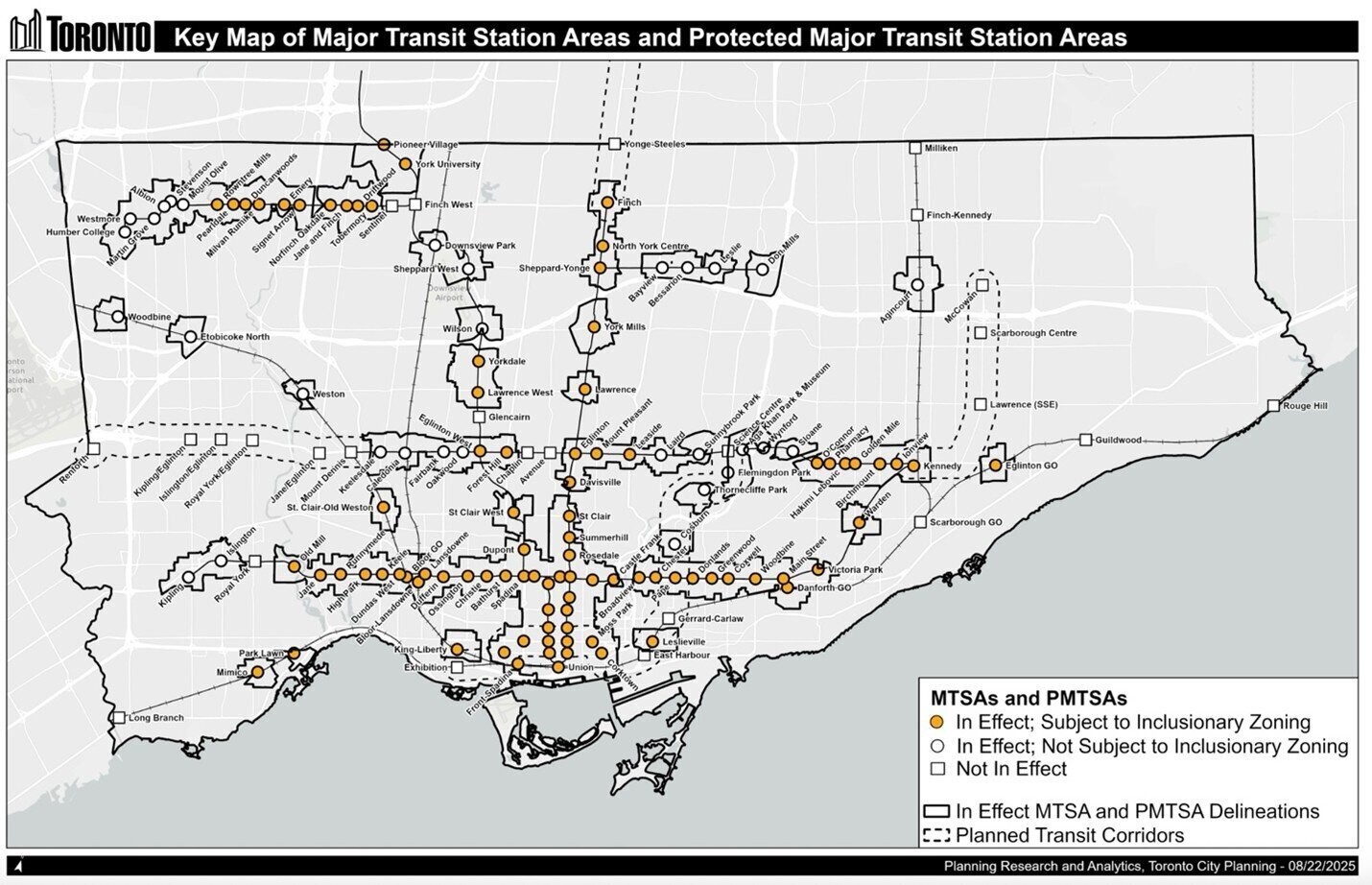
| In August 2025, the Province approved Toronto’s Major Transit Station Areas (MTSAs) and Protected Major Transit Station Areas (PMTSAs). These are defined areas within roughly a 10-minute walk of transit hubs (subway stations, GO stations and streetcar stops). There are now 120 of these areas across the city, collectively known as P/MTSAs. Inside these areas, the Province requires that the City plan for growth and development through updated zoning. In principle, these 120 new P/MTSAs replace the previous five growth areas (Downtown, Islington-Bloor, Scarborough Centre, Yonge-Sheppard and, of course, Yonge-Eglinton). This should reduce the concentration of development we have traditionally seen in these five areas. Likewise, there should be an increase in development in areas close to transit hubs that are outside of the traditional growth centres. The SEDRA-area map below shows two zones defined in the P/MTSA legislation of 200-metre and 500-metre zones around the Davisville, Eglinton, Mount Pleasant and Leaside subway stations. The dark blue zone represents 200 meters from a transit hub, and the light blue represents 500 metres. The black outline shows the full extent of each MTSA area around the four transit hubs. These station areas were initially identified in the City Planning report dated March 4, 2022. |
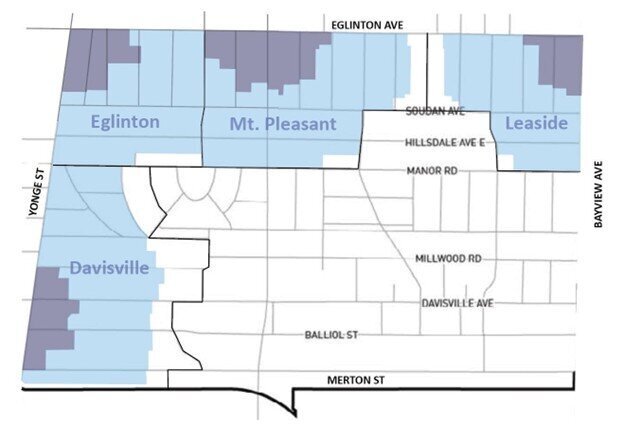 |

| The tricky part is that while these two colours represent different degrees of permitted density and building heights, these zones must be seen in combination with land uses of the City’s Official Plan, as shown below. |
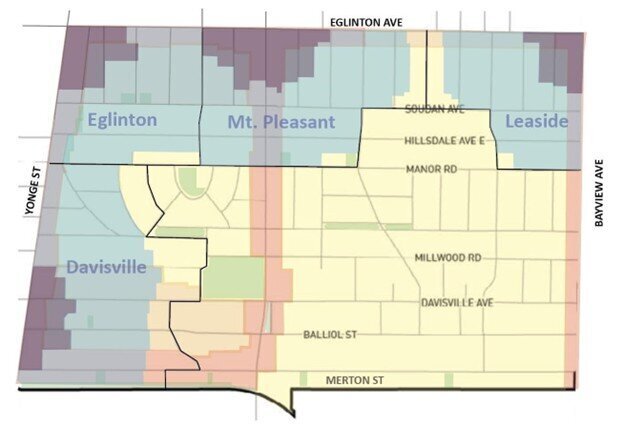 |

| The result is that the four land uses in our neighbourhood (i.e., Mixed-use, Apartment Neighbourhood, Neighbourhoods and Parks/Open Space) will be conditioned on whether a property is within 200 metres (dark blue) or 500 metres (light blue) of a transit hub. |
What the City is working on now
It goes without saying that the overlay of various planning regimes on top of each other can lead to confusion. City Planning is currently drafting the zoning by-law changes needed to implement development permissions within the P/MTSAs, while respecting Land Uses defined in the City’s Official Plan. These bylaws will define rules around parking, setbacks, angular planes, massing and density, and are expected to go to Council this spring for approval.
Here is what we know so far from both the Province and the City:
Mixed Use Areas and Apartment Neighbourhoods (Red and Orange land use areas)
- Within 200m of a station: Up to 30 storeys on large sites or up to 8 FSI (i.e., total floor area up to 8 times the site area)
- 200–500m: Up to 20 storeys on large sites or up to 6 FSI
- Even greater height/density may be possible with a comprehensive plan that delivers public benefits (e.g., parks or new streets)
Neighbourhoods (Yellow land use areas)
- Allow apartment buildings up to 6 storeys in height within 200 metres of transit stations or on lands fronting a Major Street
- Allow multiplexes and apartment buildings elsewhere up to 4 storeys in height.
Density Targets
- Davisville: 350 people/jobs per hectare (will exceed this target with currently proposed projects)
- Eglinton: 600 people/jobs per hectare (current density already exceeds this target)
- Mt. Pleasant: 350 people/jobs per hectare (current density already exceeds this target)Leaside: 200 people/jobs per hectare
Avenue Review
Overlaid on top of all this is another review taking place at the City to look at Avenues (i.e., major streets such as Yonge, Eglinton, Mount Pleasant and Bayview) which are primarily governed by mid-rise height restrictions (8 – 12 storeys) unless superseded by P/MTSA requirements.
For the SEDRA community, some of these changes will have significant impacts, while others will not. Specifically, we will see changes to applications within Neighbourhood areas within each of the four MTSAs, such as the permissions for six-storey apartment buildings as noted above. Currently, there is a four-storey limit. Conversely, permissions for up to 20 and 30 storey buildings are much lower than the heights we have seen lately for projects near Davisville and Yonge, Eglinton and Yonge, Mount Pleasant and Eglinton, and Bayview and Eglinton. Density targets proposed in the MTSA legislation are below current densities at Eglinton, Mt. Pleasant and soon Davisville hubs. We are looking to see how the City addresses this discrepancy and whether we will see an end to 30 + storey applications in our area. Looking at the Density Targets noted above, we will continue to see intensification greatest at Yonge and Eglinton, with it decreasing southward to Davisville and eastward to Mt. Pleasant and Bayview.
SEDRA Concerns
SEDRA submitted concerns to City planning in response to their Community Presentation of the MTSA legislation on January 21, 2026. Our concerns covered the following:
- Confirmation of the MTSA boundary around Mt. Pleasant and Davisville transit hubs which seem shifted eastwards. Will this raise disputes for property owners in these zones?
- Confirmation that parks and open spaces are excluded from MTSA zones; both existing parks and proposed (such as Davisville Yards). The same should apply to schools and churches, some of which are inside the 200m and 500m zones (such as Davisville JPS).
- Clarification on how the removal of parking requirements for projects within an MTSA will impact accessible parking requirements, visitor parking, deliveries, and neighbourhood streets that will be expected to accommodate the demand for tenant parking from these new developments.
- Confirmation that City Planning’s Tall Buildings Guidelines will be updated to include MTSAs and the anticipated built form expected from projects in these new zones.
We have not yet received a response from City Planning to our concerns, but have been advised that all questions from public consultations will be considered in their report to City Council addressing the new MTSA zoning criteria.
For more information on this important new planning legislation, please refer to the City of Toronto’s MTSA project home page.
SEDRA will also be providing more discussion on MTSAs at our Annual General Meeting in May.
Prepared by Jeff Latto and Al Kivi, SEDRA Board Members